
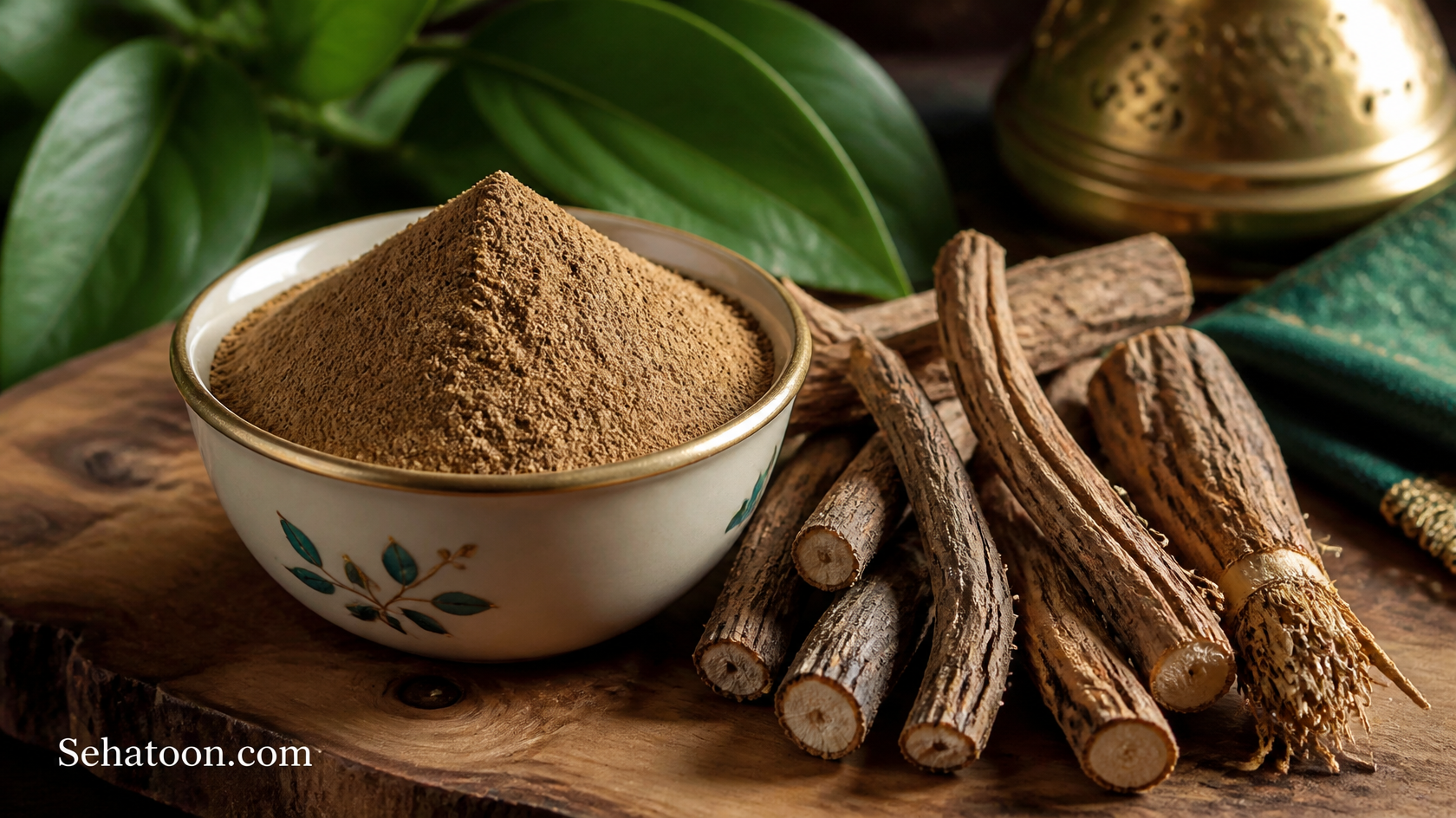
Indian Costus, also known as Al-Qust Al-Hindi or Indian Oud, is a plant mentioned in the Sunnah of Prophet Muhammad ﷺ. It has an important place in the Islamic tradition of herbal remedies.
Authentic hadiths mention Indian Costus and some of its traditional uses, especially for throat conditions and pleurisy (a condition affecting the side of the chest).
In this article, we will explore Indian Costus, its different types, what the Prophet ﷺ said about it, its commonly mentioned uses, and traditional ways of preparing it.
What Is Indian Costus?
Indian Costus is a herbal plant traditionally used in the form of roots or powder (the plant after being ground). It is known for its brown or yellowish color and its strong smell.
There are two main types:
- Indian Costus: It usually has a darker brown or yellowish color and a strong, sharp smell.
- Sea Costus: It is usually white and has a pleasant smell.
Indian Costus in the Sunnah
Indian Costus is mentioned in authentic hadiths narrated from Prophet Muhammad ﷺ.
The Prophet ﷺ said:
“The best of the remedies you use are cupping and Indian Costus.”
He ﷺ also said:
“Use this Indian Oud, for it contains seven types of healing. It is used for Al-Adhrah and by way of Al-Ladud for pleurisy.”
This hadith is reported in Sahih al-Bukhari and Sahih Muslim.
The hadith shows that Indian Costus was mentioned among the remedies recommended by the Prophet ﷺ.
Here are some words from the hadith explained in simple language:
- Seven types of healing: This means seven forms or ways of treatment.
- Al-Adhrah: A condition that affects the throat and tonsils.
- Pleurisy (Dhat Al-Janb): A condition affecting the side of the body or chest, which may cause pain in that area.
Common Uses of Indian Costus
In Prophetic Medicine and traditional herbal practices, Indian Costus is associated with several uses. Some of the commonly mentioned uses include:
1. Throat and Tonsil Problems
The hadith mentions Al-Adhrah, a condition that affects the throat and tonsils.
Indian Costus is traditionally associated with treating throat problems. One of the mentioned methods is gargling with a water extract (liquid prepared by soaking or extracting the plant in water).
2. Respiratory Health and Airways
Some herbal preparations containing Indian Costus have been associated with respiratory care. They are traditionally described as helping to widen the airways (the tubes that carry air to the lungs) and make breathing easier.
Indian Costus is also sometimes mentioned in discussions about Middle East Respiratory Syndrome (MERS), a viral respiratory illness.
3. Nosebleeds
A nosebleed, also called nasal bleeding, is the loss of blood from the nose.
Traditional uses of Indian Costus include using its water extract with a piece of cotton in connection with nosebleeds.
4. Pleurisy and Side Pain
Pleurisy (Dhat Al-Janb) is mentioned in the hadith. It is a condition associated with pain in the side of the body or chest.
Indian Costus has also been traditionally associated with this condition. Some traditional uses mention relieving internal pain, including pain related to the liver, spleen, kidneys, and back.
5. Colon, Kidney, and Back Pain
Some traditional uses of Indian Costus are related to irritable bowel syndrome (IBS), a condition that may cause stomach pain, bloating, and changes in bowel movements.
It is also mentioned in traditional herbal practices in connection with kidney and back pain, which some descriptions attribute to coldness in the body.
6. Blood Clots
There are also claims about using Indian Costus to help people recover from different types of blood clots, such as clots in the brain or legs.
Some descriptions also connect these claims with conditions that affect a person’s ability to speak.
Traditional Ways of Using Indian Costus
Several traditional methods of preparing and using Indian Costus are mentioned.
1. Gargling and Rinsing
This method involves adding hot water to ground Indian Costus and using the resulting liquid for gargling and rinsing the mouth and throat.
2. Nasal Use (Su’ut)
Su’ut is a traditional method of introducing a substance into the nose, either by inhaling it or using drops.
Using a water extract of Indian Costus through the nose is mentioned among traditional treatment methods.
3. Using a Cotton Piece
Another mentioned method involves soaking a small piece of cotton in the water extract of Indian Costus and placing it inside the nostril in connection with nosebleeds.
4. Al-Ladud
Al-Ladud is a traditional way of giving medicine through the side of the mouth rather than the middle.
It is mentioned in connection with Indian Costus and its traditional use for pleurisy and some internal pains.
Important Note: These methods are described as traditional uses of Indian Costus. They are not approved medical prescriptions. Do not try nasal inhalation, place cotton inside your nose, or take Indian Costus extracts to treat an illness without consulting a qualified healthcare professional. Indian Costus must not replace medical treatment for blood clots, respiratory diseases, or any other serious condition.
Conclusion
Indian Costus has an important place in Prophetic Medicine, and it is mentioned in authentic hadiths of Prophet Muhammad ﷺ. It comes in different types and forms, and several traditional uses and preparation methods are associated with it.
Learning what the Sunnah says about herbal remedies, understanding the meanings of the hadiths, and becoming familiar with the traditional uses of medicinal plants can help us approach Prophetic Medicine with greater knowledge and understanding.